


a bird’s eye view of conservation
June 24, 2026


American Kestrel perched on top of a tree
An American Kestrel tagged as number 56944 spent time resting and refueling at Natural Lands’ Gwynedd Preserve in Montgomery County, PA, on its migration journey from New England to Florida last year. Like many bird species, these tiny falcons are in decline. Their migration timing and routes are influenced by environmental cues and food availability, both of which are impacted by a changing climate. Studying their migratory patterns may provide insights to scientists.
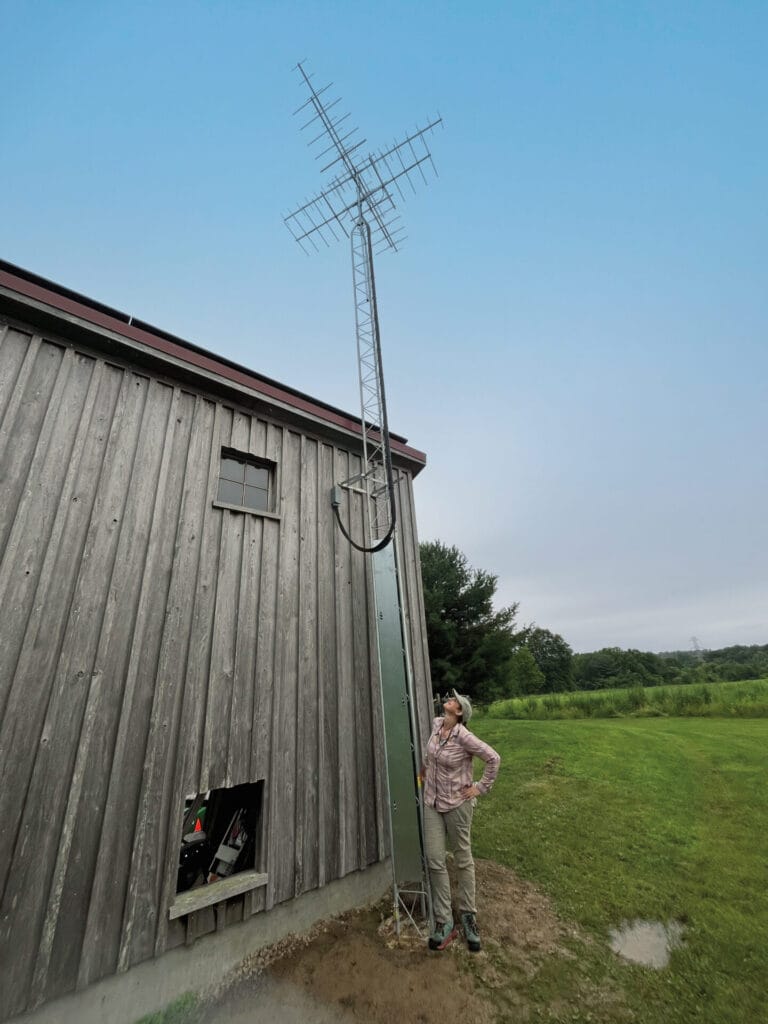
Motus tower installation at Gwynedd Preserve, photo: Claudia Winters
This particular kestrel’s movements were tracked through a program called Motus, which is the Latin word for “movement.” Created by the nonprofit organization Birds Canada, Motus is an international community working together to study the movement and behavior of birds, bats, and insects. These creatures are tagged with miniaturized transmitters that give off unique radio frequencies in short bursts. The tags “ping” when in proximity to Motus stations placed across the world. These stations are like radio towers and have antennas that collect a range of frequencies. Currently, there are more than 2,300 towers in 34 different countries—including newly installed stations at Gwynedd Preserve and Glades Wildlife Refuge.
The tiny tags are appropriately sized for each type of animal and stay in place with lightweight harnesses. Wildlife safety and quality of life is paramount; tagging equipment must not amount to more than three percent of the animal’s body weight.
“Banding birds and conducting bird surveys are valuable tools for monitoring birds, but they only tell us part of the story,” said Claudia Winters, bird conservation program manager for Natural Lands. “A bird may never be recorded again after it’s banded, but a Motus-tagged bird will send signals to every tower it passes for as long as the tag’s battery lasts. And that information is available to everyone—scientists and laypeople alike—through the Motus website.” Claudia’s position as bird conservation program manager is a newly created one for Natural Lands, reflecting an increased focus on how birds and other wildlife can help inform our conservation priorities.
canaries in the coal mine.
Birds are biological barometers that can reveal the health of our natural areas. Because they are sensitive to environmental shifts, their presence and diversity can signal intact, high-functioning ecosystems that might otherwise look unremarkable. What’s more, tracking bird migration patterns allows researchers to identify “climate refugia”—areas that remain stable enough to support life as other habitats degrade due to temperature changes and extreme weather events.
Simply put, bird species data are helping Natural Lands determine where to focus our land conservation efforts.
Said Todd Sampsell, vice president of conservation, “Resilient landscapes are ones that can withstand stressors—big storms, changing weather patterns, floods and drought, loss of habitat. Our work saving open space can help build resiliency against these very real and pressing issues. But we must know what to prioritize.”
“It’s certainly not the only data we are using,” Todd continued. “In fact, we layer a number of data sets into mapping software—things like development pressure, stream impairment, flooding susceptibility are included—but wildlife populations are an important data point. Sadly, birds are some of the most at-risk species and so are really telling indicators.”
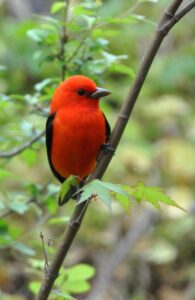
Scarlet Tanager, photo: Luc Jacobs
The Scarlet Tanager is a useful case study, as Pennsylvania supports 17 percent of this species’ global population. These vibrantly colored songbirds arrive to our region in late spring from South America to breed. They build their nests 50 feet high in the treetops where they then rear a clutch of three to five young.
Scarlet Tanagers need dense, unbroken forests that are not bisected by roads or power lines. These man-made features create “edge habitat” where racoons, Blue Jays, and Brown-headed Cowbirds thrive and prey on or displace the eggs of Scarlet Tanagers. Studies have found that Scarlet Tanager nests located in deep forests have a success rate of 64 percent. This is compared to only a 22 percent success rate when the nests are in small woodlands with significant edge.
Once their vulnerable eggs have hatched, both male and female Scarlet Tanagers work tirelessly to find enough insects for their hungry brood. They make trips back to the nest every 20 minutes with caterpillars, beetles, and other large arthropods. In areas where the forest cover is broken by development, the birds are forced to fly farther and are exposed to hawks and other predators.
Of course, the Scarlet Tanager is just one vulnerable species whose numbers have declined over the last few decades. However, research shows that a healthy diversity of bird species often correlates with the presence of other, harder-to-track species like butterflies and aquatic life. Therefore, protecting habitat where birds are thriving means we can safeguard entire biological communities.
“Once we look at the connection between birds like the Scarlet Tanager and the habitats they depend on, we can use this knowledge to inform our conservation work,” said Todd. “The largest forested landscape in our region is the Kittatinny Ridge, which has become an area of increased interest for us when evaluating land protection opportunities.”
The Kittatinny Ridge, which roughly translates to “endless mountain” in Lenape, stretches for 185-miles across 12 counties from the Maryland border to the Delaware Water Gap. Its vast, forested geography serves as a migration superhighway for more than 150 different species of neotropical migrants, including the Scarlet Tanager, Cerulean Warbler, Wood Thrush, and Ruby-throated Hummingbird. Thousands of hawks, eagles, and other raptors ride the thermal winds created by the Ridge’s steep slopes. Beyond birds, the Kittatinny Ridge offers sheltered passage to Monarch Butterflies, nine different species of bats, and myriad mammals.
It was even used by American Kestrel number 56944, whose tag pinged 11 Motus stations—including the one at Gwynedd Preserve—along its migration route.
taking nature under our wing.
In addition to helping us determine where to protect land, studying birds can also tell us how to steward land already under Natural Lands’ care. For a good example of this, we turn from forests to fields.
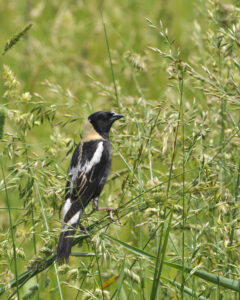
Bobolink, photo by Jim Moffett
“Bobolinks are really charismatic birds,” Claudia Winters said with a smile. “During spring breeding, males sing a bubbling, rambling song while acrobatically diving and hovering over the meadows. They sound like R2D2 from Star Wars.”
These migratory songbirds travel about 12,500 miles round trip each year back and forth between their wintering grounds in South America and their breeding region in the northern U.S. Quite the opposite of Scarlet Tanagers, Bobolinks build their nests in open fields and meadows, tucked between clumps of grasses on the ground.
Bobolinks and other grassland nesting birds are declining faster than any other group of birds. Their population has plummeted by more than half since 1970 due to land development and changing farming practices.
In the past, farmers mowed hay fields once or twice a summer, usually in late July. Modern agricultural technology and the demand for high-protein “green chop” for dairy cows have shifted mowing as early as May and is often repeated every 30 days.
“This essentially creates a trap. Ground-nesting birds are drawn to a lush field as a nesting site in early spring only to have their nest—along with any chicks or baby birds—destroyed when the hay is cut,” said Claudia. “Even if they manage to lay another clutch of eggs, there isn’t enough time for them to hatch and the young to fledge before a second haying.”
By delaying mowing until July 15, Natural Lands ensures the meadows and agricultural fields on our preserves are safe havens for ground-nesting species.
To help spread the word, Natural Lands is part of the Grassland Bird Collaboration, an effort spearheaded by Willistown Conservation Trust and the Cornell Land Trust Bird Conservation Initiative. The Collaboration reaches out to Chester County property owners and farmers to provide guidance on best management practices to benefit vulnerable birds. Because much of Chester County’s hay is purchased by local mushroom farmers for compost rather than to feed dairy cows, it doesn’t need to be high in protein and can be harvested late.
Other bird species are being used to evaluate and adjust land stewardship practices. Audubon Vermont uses bird data to teach foresters how to maintain a layered forest composition including standing dead trees for woodpeckers and thick shrub layers for Black-throated Blue Warblers. Middle Susquehanna Riverkeeper Association is measuring the impact of forested “buffers” along stream banks by monitoring the population of Louisiana Waterthrush, a key indicator of riparian health. And the Institute for Bird Populations studies the number of Ovenbirds to evaluate understory forest health, linking overpopulation of hungry white-tailed deer to declines in this species’ population.
Last summer, Claudia Winters was checking a kestrel nest box at Stroud Preserve in Chester County, PA. She’d come to band the nestlings in the box so they might someday contribute data for future conservation studies. “I found an adult female in the box with her nestlings, and she already had a band on her leg,” recounted Claudia. When she submitted the band number to the Bird Banding Laboratory at the U.S. Geological Survey, she learned the band had been put on by a Natural Lands staff member in Salem County, NJ, seven years earlier.
“The average lifespan of an American Kestrel is between two and five years, so it was fantastic to find one still successfully mating and rearing young at this age,” says Claudia. “I know it’s just one bird, but it gives me hope that Natural Lands is making a difference by saving land, stewarding it thoughtfully, and studying the wildlife that rely on it.”
against the odds.
Last May, a group of Natural Lands donors and volunteers enjoyed an exclusive tour of Glades Wildlife Refuge in Cumberland County, NJ. A highlight of the trip was a visit to Raybin’s Beach where, every spring, thousands of Red Knots land to feast on horseshoe crab eggs. These migratory shorebirds travel an astonishing 20,000 miles annually between the Arctic and South America. Without this important refueling layover along the Delaware Bayshore, they would not survive the journey.
Participant Mike Niven snapped this photo of a Red Knot and, when looking at his photos later, noted the bands on both legs. Natural Lands staff submitted the band numbers to the U.S. Geological Survey and learned this bird had been banded 11 years earlier and is estimated to be 13 years old. The average lifespan of a typical Red Knot is three to five years.
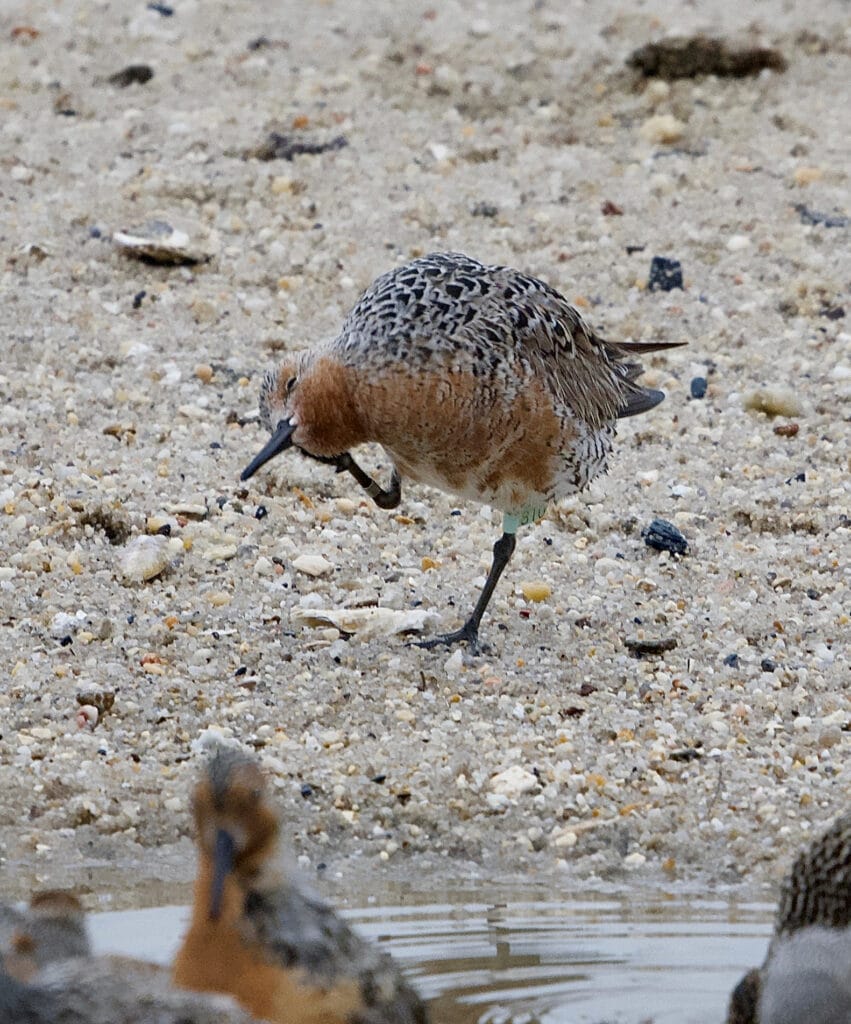
banded Red Knot, photo: Mike Niven
The math would suggest that this extraordinary bird has migrated about a quarter of a million miles in its lifetime, roughly equivalent to the distance between Earth and the Moon. By protecting the tidal shoreline it depends on, Natural Lands is ensuring that this bird and others like it can thrive.
next post


Red Maples - the Kings of Crimson
June 22, 2026
By Anthony D. Fredericks, guest blogger Red leaves in autumn; red flowers in spring; and red twigs, buds, and stems make red maples (Acer rubrum) […]
continue reading