


bioluminescent lightshow at Mariton
June 30, 2026


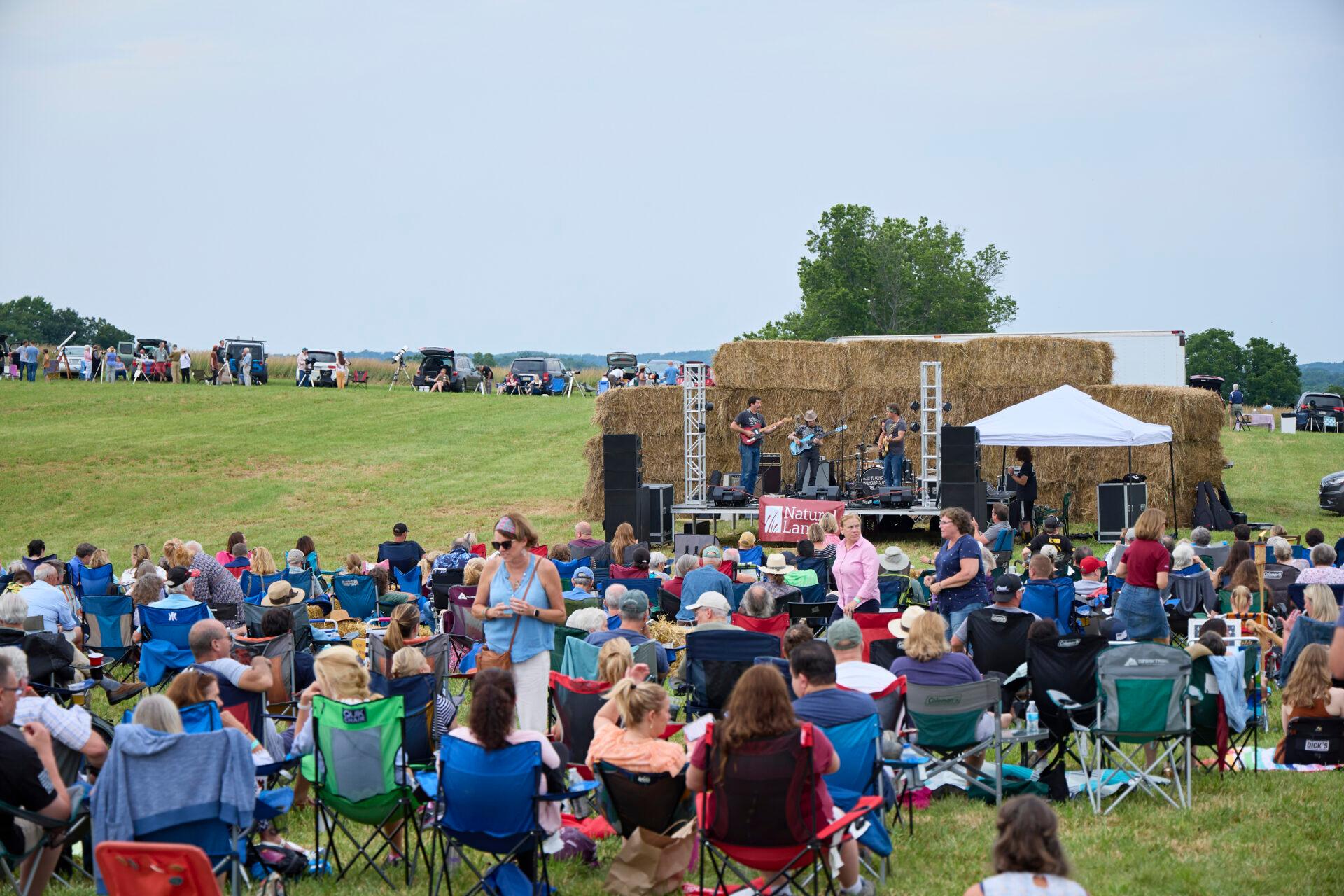
Bioluminescent Lightshow event at Mariton Wildlife Sanctuary, photo by Tianna Godsey
By Tianna Godsey, events coordinator
We had an absolutely fantastic Bioluminescent Lightshow on June 27, 2026, at Mariton Wildlife Sanctuary. Attendees kept saying they haven’t seen fireflies like this since they were young and recognized the type of environment and native plant ecosystem that must be maintained for this to be a reality.
Preserve Manager Zane Miller began the evening with a wonderful presentation on some of the genera/species we might see at Mariton that night, going over the commonly seen fireflies, and what we might expect as the evening grew darker and fireflies began to emerge in full lightning force.
Some really cool findings from the evening included: Photinus marginellus (Little Gray Firefly), with a salmon-pink light, and its common counterpart, Photinus scintillans (Pine Barrens or Pale Firefly), discovered through the larval-type female. We also found some of the common fireflies we expected to see, before the evening was taken over by the predatory Photuris (including some definite femme fatales mocking the light patterns/behaviors).
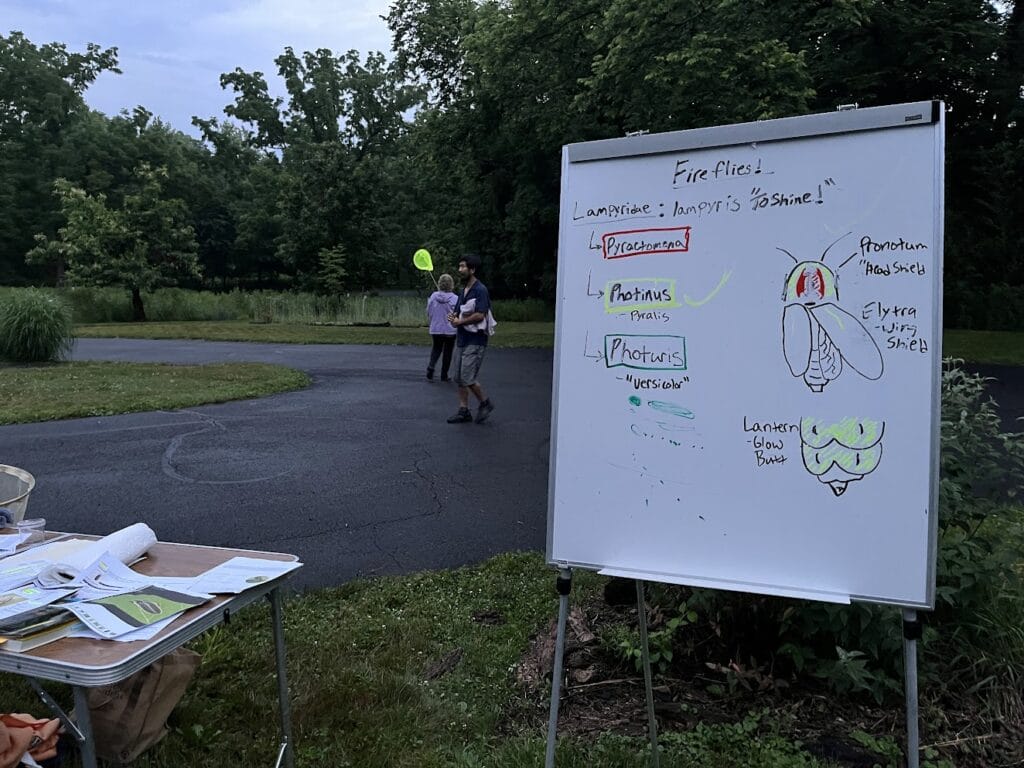
participants with nets to capture (temporarily) fireflies for identification, photo by Tianna Godsey
A full list of the species discovered thus far at Mariton:
• Ellychnia corrusca
• Lucidota atra
• Pyractomena angulata
• Pyractomena borealis
• Photinus macdermotti
• Photinus marginellus
• Photinus pyralis
• Photinus scintillans
• Photuris pensylvanica
• Photuris versicolor
Suspected:
• Photuris lucicrescens
• Photuris tremulans
It’s almost impossible to count how many unique light patterns and behaviors we witnessed that evening, but it was enough to leave everyone in awe. We saw yellow flashes, orange flashes, bright green flashes (including dot-dash and falling comet-type flashes), blue-green, and white-blue. One observation made toward the end of the evening is how it is often easier to notice the different patterns and colors when you don’t focus directly on them but try to catch the lights in your peripheral vision.
Firefly studies are a growing community science project, and one that doesn’t have a lot of local experts. This makes it a very accessible form of community science to get involved in through iNaturalist. All you have to do is begin to pay attention to the fireflies you see, even in your backyard. Next time you see one, pay attention to its flash pattern and behavior—and if you’re able to capture it, take a photo of its back and the elytra (wings), and the stomach including the butt-lights. These are both helpful for identification. Here is more information on all of that.
Happy summertime!
next post


a bird’s eye view of conservation
June 24, 2026
Natural Lands is using Motus towers and the migration data they provide to help inform our land conservation and stewardship work.
