


Stoneleigh is growing.
May 24, 2026


Photo: David Korbonits
It’s rare that a botanic garden has the opportunity to expand by nearly 25 percent. It is even more rare to reunite properties that were subdivided nearly 100 years ago, but that’s exactly what will happen soon at Stoneleigh: a natural garden.
Stoneleigh’s 42-acre footprint will grow to 52, marking the reunification of two historic landscapes. The 10-acre addition represents the majority of an adjacent property known as Oakwell, which was subdivided from the Stoneleigh estate in the 1920s and 30s. The view into Oakwell from Stoneleigh’s northernmost garden path is remarkable in its similarity—towering trees, stately architecture, and remnants of significant garden designs.
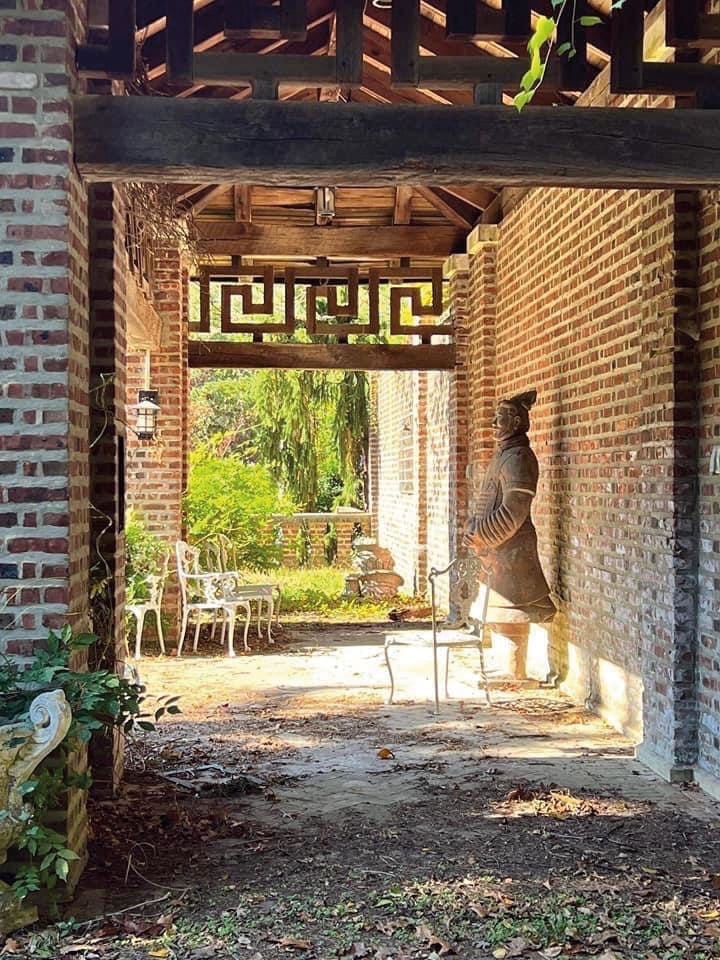
Photo courtesy of Shawn Nagl
What had once been a cohesive landscape has been divided by a property line and a tall fence for more than a century.
The reunion story began in an unusual way and involved an unanticipated partner. In 2018, Lower Merion School District purchased the 13-acre Oakwell property from three private homeowners to create athletic fields for a planned middle school nearby.
Five years after they acquired Oakwell, the school district’s plans changed as they faced public concern about the loss of the historic landscape and buildings. The district began conversations with Natural Lands focusing on alternatives for the property. One year later, the two parties announced they’d reached an agreement. The school district would sell 10 acres of the Oakwell property to Natural Lands to be added to Stoneleigh and the remaining three acres to the Wyncote Foundation, which will restore and preserve the Oakwell mansion.
Very shortly, those sales will be finalized.
Oakwell is saved, and Stoneleigh is growing.
“We are thrilled to have the opportunity to preserve Oakwell as part of Stoneleigh. We are immensely grateful to the current leadership of the Lower Merion School District and to the community for its support,” said Oliver Bass, president of Natural Lands. “It is not an exaggeration to say that this is the culmination of years of work by our staff, our supporters, and members of the Lower Merion community. The township commissioners dedicated countless hours to public engagement and decision making to help protect this historic landscape and ensure it would be available for public use.”
While it will be a few years before this new addition to Stoneleigh is open to the public, this expansion will further Stoneleigh’s mission: to celebrate the beauty and importance of the natural world and inspire the cultivation of native plants for the benefit of all. A new Master Plan for Stoneleigh offers a blueprint for weaving the two properties into one, adding capacity for expanded educational programs, enhancing guest amenities, and honoring the history of the landscape.
“We are honored to reunite Oakwell with Stoneleigh in a way that pays homage to their shared and distinct histories while also incorporating new garden features,” said Ethan Kauffman, director of Stoneleigh. “Oakwell is a magical place with some truly spectacular trees and beautiful buildings, and we can’t wait to share it with the community when it’s ready. Honestly, I have to pinch myself to believe this opportunity is real.”
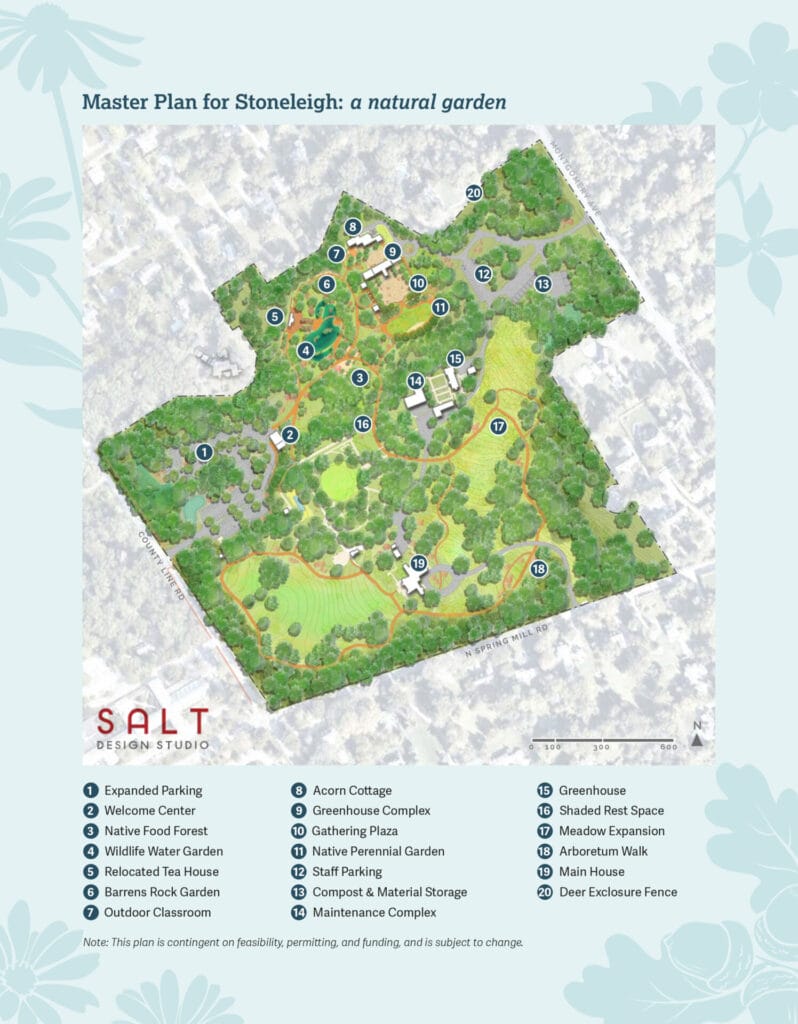
Note: This plan is contingent on feasibility, permitting, and funding, and is subject to change.
Highlights of the Master Plan for the expanded Stoneleigh include:
- We will limit disturbance in areas with healthy, mature trees. For example, an expanded parking area will wind around mature specimens to create “parking rooms” among the trees rather than one large lot. A detailed study of significant trees informed this approach.
- We will construct a new Welcome Center to greet and orient garden guests every season of the year.
- We will create new garden spaces to inspire guests, offer new learning opportunities, and support local wildlife.
- We will remove physical barriers between Stoneleigh and Oakwell, truly reunifying the two properties. Removing some of the old, asphalt driveways will improve circulation while new pathways will reduce overlap between garden guests and operations traffic.
- We will add capacity for educational programming by creating both indoor and outdoor classrooms.
- We will develop opportunities for community connections through new gathering spaces and innovative partnerships.
- We will honor the history of the landscape, which has been shaped by some of the most influential landscape architects of the 19th and 20th centuries.
“None of this would be possible without the exceptionally generous support of the Wyncote Foundation with additional leadership support provided by the William Penn Foundation,” said Oliver Bass. “Stoneleigh is growing in so many ways. We look forward to the day we will welcome everyone to experience all the joys of Natural Lands’ now 52-acre public garden.”
the power of community.
Deb Robbins insists she isn’t a hero. Nor did she have any previous experience in community organizing. But that didn’t stop the Lower Merion resident from co-founding a groundswell of supporters that banded together under the banner of Save Oakwell.
“It started with just a few of us talking about how significant the loss of this place would be and it snowballed,” said Deb. “There was no hierarchy. It was just a growing group of neighbors who wanted to raise awareness in the community about this issue.”
Concern about Oakwell’s future grew as plans for development received more public attention. Friends and neighbors were dismayed at the thought of the property’s towering trees, historic buildings, and horticultural legacy being lost. For two years, students, parents, and residents spoke out at school board meetings, protested in public spaces, and activated attention on social media.
Deb recalls the fledgling Save Oakwell group gathering at Stoneleigh to peer through the fence at Oakwell’s centuries-old trees and historic buildings. The then owner invited them to tour the property and see its treasures up close, including a 150-year-old dwarf blue spruce, a 200-year-old maple, and a 250-year-old oak.
With the owner’s permission, public tours led by Save Oakwell began in earnest. “We knew if more people experienced the peace, natural beauty, and specialness of Oakwell, they’d want to fight to save it, too,” said Deb. Thousands of visitors showed up, including students from the very school district that wanted to turn Oakwell into ball fields.
“I remember my first visit to Oakwell and I was simply blown away,” said Erin Betley, a conservation biologist, Lower Merion resident, and mother of Lower Merion School District students. “The history there… so much of it had been forgotten. I became really determined to unearth these lost stories and share them with the community.”
Erin was particularly moved by the students who began to speak out against the property’s development. Together with young people, local educators, scientists, and community activists, they co-created a complementary effort called Grow Oakwell. Their website—created by fellow advocate Julia Steinberg Agnew—contained a wide range of information, including the history of Stoneleigh and Oakwell, tree species lists, community BioBlitz findings, maps, a virtual tour, media articles, a petition, and much more.
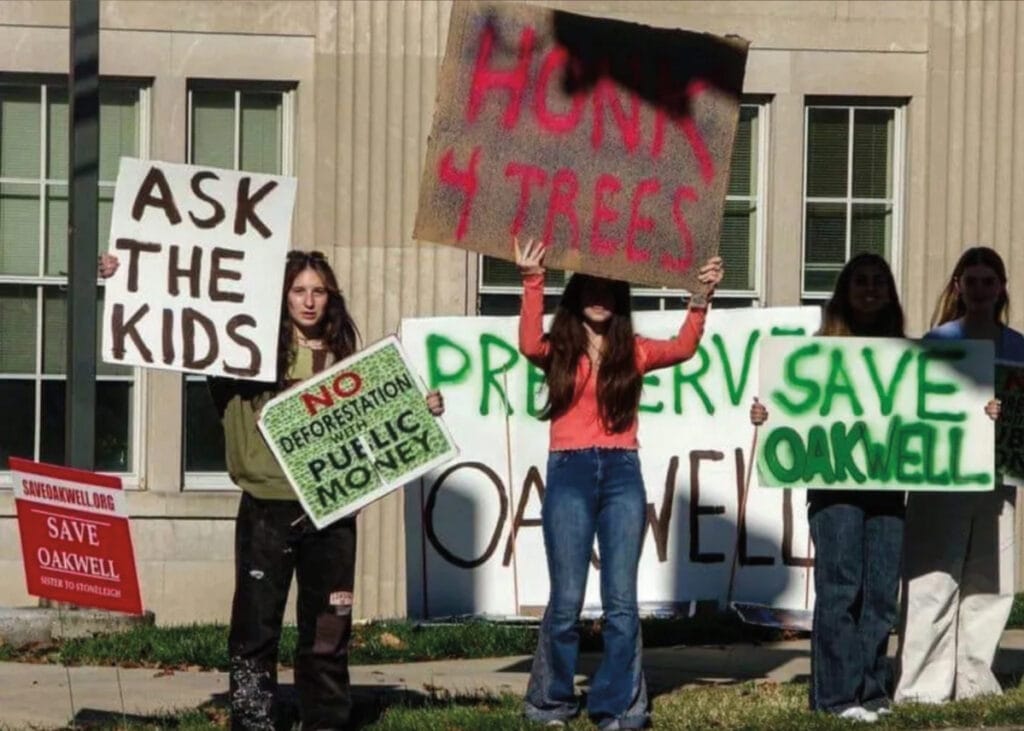
Photo courtesy of Preserve Oakwell
Lower Merion students packed the aisles at a November 2022 School Board meeting, all cheering on 12 student speakers ranging from 4th to 12th grade from four different schools. In coordinated presentations, they shared compiled information as well as their own original research and a proposal for an alternative, transformative vision for Oakwell’s future. Erin Betley wells up recounting this. “They’d never spoken at a formal meeting like this before. I know they were nervous, but they were so passionate, articulate, and spoke from the heart. It was so moving then and still moving to me now.”
“There was a lot of talk about what not to do with Oakwell, but very little about what to do,” said Erin. “Grow Oakwell wanted to envision what it could be for the students and the community. That was the impetus behind the proposal for the Action Center for Organizing Resilience and Natural Sustainability Education (ACORNSE).”
Spearheaded by the Lower Merion High School Environmental Club, the ACORNSE proposal envisioned Oakwell as an educational space for hands-on learning in the sciences, history, and agriculture, and as a gathering place for the broader community.
How fitting, then, that this vision is mapped out in the Master Plan for Stoneleigh.
voices of young conservationists.
“Oakwell stands as living proof that individual action can make a difference; your imagination and voice hold a lot more power than you think. Chances are, other people care about change as much as you do, so get to know those within your community, mobilize, and speak up.”
– Noa Fohrer, Lower Merion HS class of 2023, now at College of the Atlantic
“Oakwell is my “why” when people ask me today how I got into my field of climate education. Being a part of such a strong team of students was the most inspiring experience I’ve had.”
– Willa Godfrey, Lower Merion HS class of 2024, now at Northeastern University
“Save Oakwell was my first foray into social movement work and it gave me the foundation I’ve used on a lot of campaigns since. Oakwell shaped the way I think about the world. It showed me that the world is mostly beautiful, people are mostly kind, and, at their core, everyone wants to do good.”
– Sam Donagi, Lower Merion HS class of 2025, now at New York University
“I got involved when I was in 4th grade. I went on a tour of the property and was immediately upset that it would be destroyed. I decided to speak in front of the superintendent and school board. Knowing that I, among others, could produce that amount of change really empowers me.”
– Greta Agnew, Lower Merion HS class of 2031
Stoneleigh & Oakwell timeline.
- 1877 – Edmund Smith and Arabella Barnes Smith acquire 65 acres of land for a “gentleman’s farm,” complete with a c.1878 Eastlake-style residence designed by Philadelphia architect Joseph Wilson. They call their estate Stoneleigh. Other improvements include a garden, icehouse, stable, tenant house, and curvilinear carriage pathways designed by landscape gardener Charles H. Miller, who trained at Kew Gardens in England and later served as chief gardener for Fairmount Park.
-
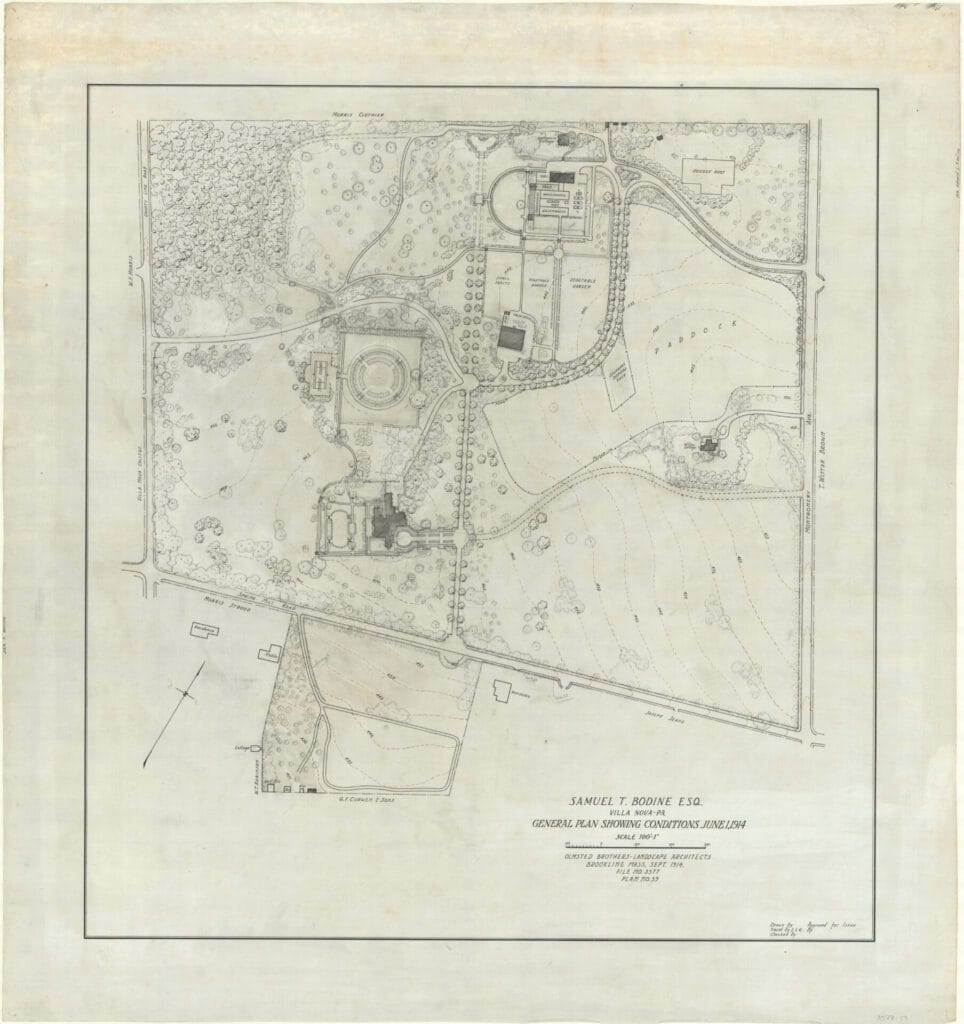
1914 Map showing Olmstead Brothers’ plans at Oakwell
Circa 1900 – Samuel Bodine and Eleanor Gray Warden Bodine acquire Stoneleigh and steer the gardens to a more formal “Beaux Arts” style with the designs of landscape architects Pentecost & Vitale. The Bodines build the Tea House, Superintendent’s Cottage (later known as Acorn Cottage), and Greenhouse Complex, the latter two designed by Frank Miles Day and Brother. They demolish the Smith residence and build the Tudor Revival-style building that exists today as the Main House.
- 1908 – The Bodines hire the preeminent landscape architects of the early 20th century, Olmsted Brothers. They transform Stoneleigh over the next 50 years, guided by a strong commitment to preserving the property’s heritage trees.
- Circa 1916 – Eleanor Bodine creates a gardening and horticultural training program for young women. She directs the establishment of community war gardens totaling more than three acres to supply produce during WWI.
- Circa 1920 – Samuel Bodine conveys nearly seven acres to his son and daughter-in-law, William and Angela. William Bodine constructs a Tudor Revival-style mansion, designed by architect William Wayne Jr., on a portion of the property and names it “Oakwell.”
- 1935 – After Samuel Bodine’s death, the Stoneleigh estate is subdivided. Twenty-two acres are sold to Otto and Phoebe Waterman Haas. Approximately 12 acres revert to William Bodine, including the Greenhouse Complex, Acorn Cottage, and the Tea House. The interior greenhouses at the Greenhouse Complex are mostly removed and replaced with a tennis court, yet the exterior brick walls remain. The remaining subdivided acres change hands over the years.
- 1964 – Otto and Phoebe’s son, John, and his wife, Chara, take up stewardship of Stoneleigh and live there for the next five decades, raising their family.
- 1986 – The Bodine family sells the then 13-acre Oakwell estate.
- 1996 – John and Chara Haas place the then 42-acre Stoneleigh under conservation easement with Natural Lands.
- 2016 – The Haas family gifts Stoneleigh to Natural Lands following John’s and Chara’s deaths.
- 2018 – Stoneleigh: opens to the public, showcasing the use of native plants in a formal setting.
- 2026 – Stoneleigh will grow to 52 acres when Natural Lands acquires 10 acres of Oakwell from the Lower Merion School District.
next post


Nature + Art = NextGen Stress Relief
May 13, 2026
By Jonathan Long, NextGen Council member Hello all, my name is Jonathan Long. I’m a member of Natural Lands’ NextGen Council. For a day job, […]
continue reading