


Eastern Hemlock: Redwood of the East
September 10, 2026


eastern hemlocks at Bear Creek Preserve
By Anthony D. Fredericks, guest blogger
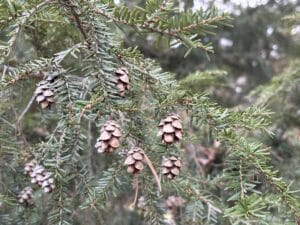
Photo: Sam Nestory
Eastern hemlocks (Tsuga canadensis)—the state tree of Pennsylvania—are often cited as one of the great trees of eastern North America. Extant in several Natural Lands preserves, their name is misleading. They aren’t related to the poisonous hemlock plant associated with Socrates but, rather, are conifers belonging to the pine family (Pinaceae). They are noted by their graceful, drooping branches, tiny evergreen needles, and deeply furrowed bark. Often long-lived (200 to 300 years), one Pennsylvania specimen has reached the grand old age of 554 years. Besides their arboreal beauty, they have several other distinguishing features. Let’s take a look.
- Native Americans used eastern hemlocks in several different ways: medicines, construction materials, and basketry. Early American pioneers used the tree’s leafy twigs to make tea and the tree’s branches as brooms.
- The bark of eastern hemlocks is rich in tannins—a natural substance used to tan animal hides. In the 1800s, substantial quantities of hemlock bark were harvested for tanneries.
- Their nickname is “Redwood of the East,” a reflection of their potential for impressive size and longevity. Hemlocks are, of course, nowhere near the size of the giant redwoods in California.
- A mature eastern hemlock often reaches a height of 100 feet or more. Exceptionally large specimens can soar up to 170 feet in height.
- Dense hemlock forests can produce remarkably cool, shaded environments. When they grow alongside mountain streams, they help keep the water cool for select fish species such as brook trout.
- Each short, flat needle on an eastern hemlock tree has two pale white lines on its underside (an easy way to identify the species). These lines are made up largely of rows of tiny pores known as stomata, which help regulate gas exchange.
- Eastern hemlock cones are only about ½ to ¾ inch long—surprisingly small for such a massive tree. The cones mature in their first year and release winged seeds.
- One of the most impressive attributes of eastern hemlock forests is that they provide shelter and nesting habitat for numerous birds and mammals. Deer, porcupines, squirrels, and other animals also use various parts of the tree.
- The hemlock wooly adelgid, an insect accidentally introduced to North America from Asia, feeds on hemlocks and can kill mature trees within several years. Its presence has dramatically altered many eastern hemlock forests.
- When an eastern hemlock dies and falls, the decaying trunk often provides a moist, nutrient-rich place where new plants can germinate and grow and where various animals can shelter and reproduce.
Anthony D. Fredericks (www.anthonydfredericks.com) is the best-selling author of The Healing Wisdom of the Forest: Timeless Lessons of Renewal, Tranquility and Joy. He lives in York, PA.
next post


Crow's Nest: Art in Nature
September 4, 2026
by Daniel Barringer, Preserve Manager. One might ask, what role does art play on our preserves? You know the expression, “Food tastes better outdoors”? That […]
continue reading