



skunk cabbage – hot and stinky
March 18, 2026


The leaves of a skunk cabbage covered with dew at Willisbrook preserve in early spring. Photo by Ralph Hall.
by Anthony D. Fredericks, guest blogger
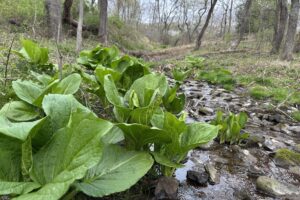
Photo by Daniel Barringer
It’s one of the first plants to bloom in late winter or early spring—one that generates its own heat, has a disgusting smell, and is found throughout Natural Lands’ properties. So, too, does skunk cabbage (Symplocarpus foetidus) have a variety of names including eastern skunk cabbage, swamp cabbage, clumpfoot cabbage, meadow cabbage, foetid pothos, or polecat weed.
But skunk cabbage also has many distinguishing features: an abundance of botanical oddities unlike any other plant. Let’s take a look.
- The plant’s range extends from Minnesota in the west to eastern Canada and the northeastern U.S. It is also found in the states of North Carolina and Tennessee (where it is protected as an endangered species). Its primary habitats include marshes, wet woodlands, and stream banks. It thrives in muddy, oxygen-poor soil where other plants struggle.
- Skunk cabbage belongs to the ancient plant family Araceae. Fossils from the Araceae family appear in the Early Cretaceous Period, roughly 120 million years ago. This was a time when the supercontinent of Pangaea began breaking apart and when flowering plants were just beginning to evolve.
- It’s species name—foetidus—is Latin for “bad smelling” and does it ever live up to its reputation as an olfactory wonder. Its distinct skunk-like/decaying flesh smell attracts pollinators like beetles and blowflies.
- Through a process known as thermogenesis, skunk cabbage can generate heat, raising the temperature around its flowers by up to 15-35°F (or an overall temperature of 60-70°F), melting any surrounding snow or ice. This helps potential pollinators access the plant even in freezing conditions.
- Unlike many other plants, its large cabbage-like leaves don’t appear until after flowering. Essentially, it blooms before it has leaves.
- The plant contains calcium oxalate crystals that can cause a burning sensation and irritation if eaten raw. Nevertheless, bears will sometimes eat the massive roots after emerging from hibernation. Those roots are also contractile, pulling the plant deeper into the soil over time.
- Several Native American tribes used skunk cabbage for respiratory ailments like coughs and asthma. Some tribes even considered it a protective plant to dispel evil spirits. Early American travelers believed skunk cabbage’s ability to grow in deep mud and rise above water was a distinctive marker in treacherous terrains.
- In ancient times it was sometimes believed that planting skunk cabbage near a home would bring prosperity and renewal to the inhabitants. In modern garden folklore, it is often referred to as a “wizard plant” because it can generate its own heat, emit smoke-like steam, and simply smell terrible.
Anthony D. Fredericks (www.anthonydfredericks.com) is the author of In Search of the Old Ones: An Odyssey among Ancient Trees. He lives in York, PA.
next post


Discovering Natural Lands with Bella at Saunders Woods Preserve
March 11, 2026
By Eduardo Dueñas, NextGen Council member Hi, everyone. My name is Eduardo Duenas, and I’m proud to serve as a member of the Natural Lands’ […]
continue reading