


meadows + fire = life
October 31, 2025
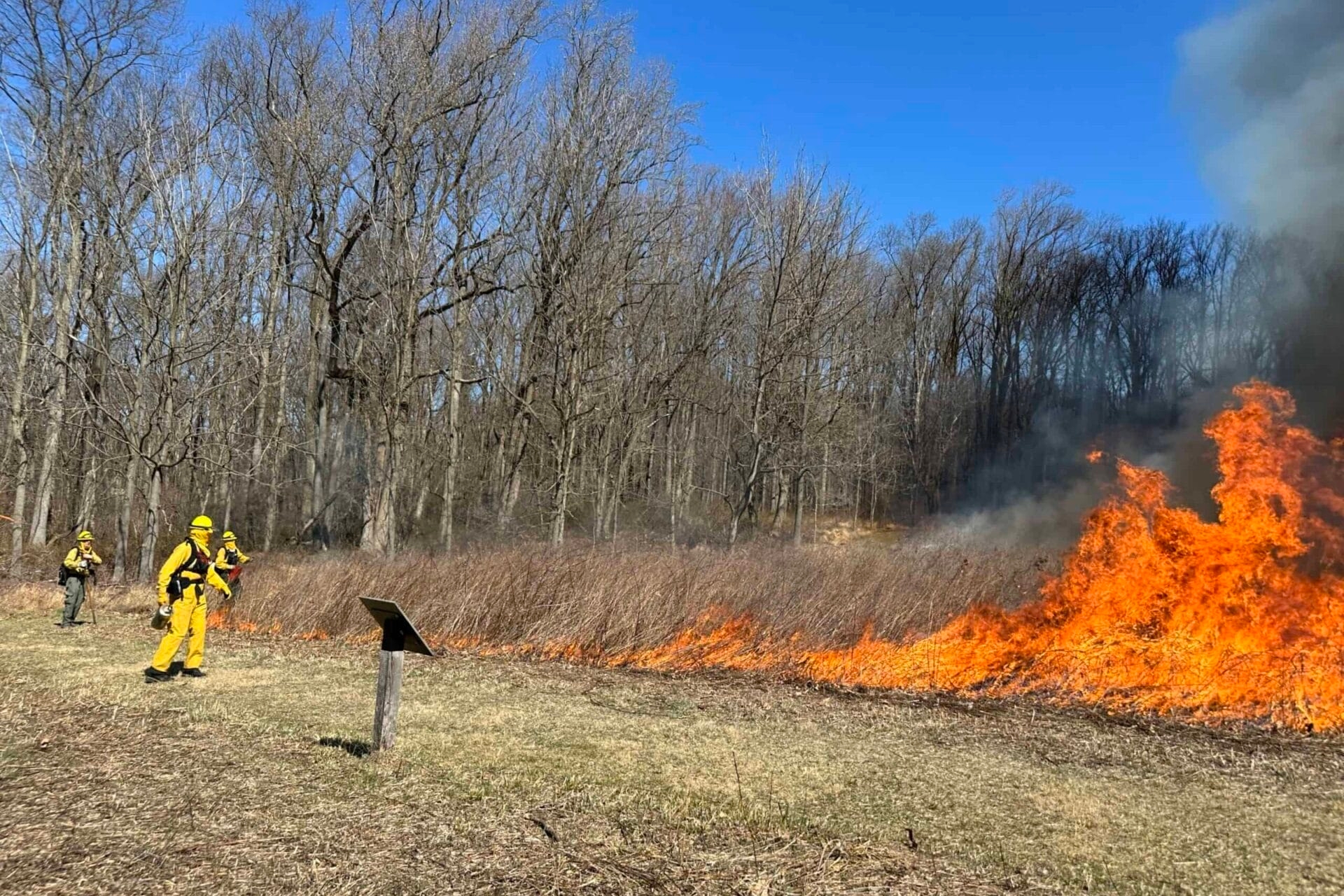

Prescribed fire in progress at Crow’s Nest Preserve
By Kit Werner, Senior Director of Communications
Say the word “prairie,” and most of us picture the vast plains of the Midwest. In contrast, the northeastern U.S. is the land of would-be woods, where every farm field and meadow quickly reverts to forest without intervention. Yet early accounts of this region—“Penn’s Woods,” as colonists named it—reveal a far more nuanced picture of Pennsylvania’s native ecology. One that included thriving eastern prairies that evolved with fire.
Some 400 years ago, English explorers of the North American continent were met with awesome expanses of grasslands. With no word for this habitat type, they adopted the French term for meadow: prairie.
Contrary to the common belief that the northeastern U.S. was once entirely forested, historical accounts depict tall meadows and broad savannahs tended with fire by Indigenous communities. Regional placenames are another clue. Southwest Philadelphia’s Kingsessing is derived from the Lenape word for “place where there is a meadow.” The Wyoming Valley region around Wilkes-Barre takes its name from a corruption of the Indigenous word for “great meadows.”
Eastern prairies have long disappeared throughout their range in the face of farming and development. The removal of native people and their millennia-old relationships with the land—particularly, their seasonal controlled burns that held back trees and regenerated the grasslands—have further ensured the decline of these unique meadow ecologies.
On Natural Lands’ nature preserves, however, prairies are making a big comeback.
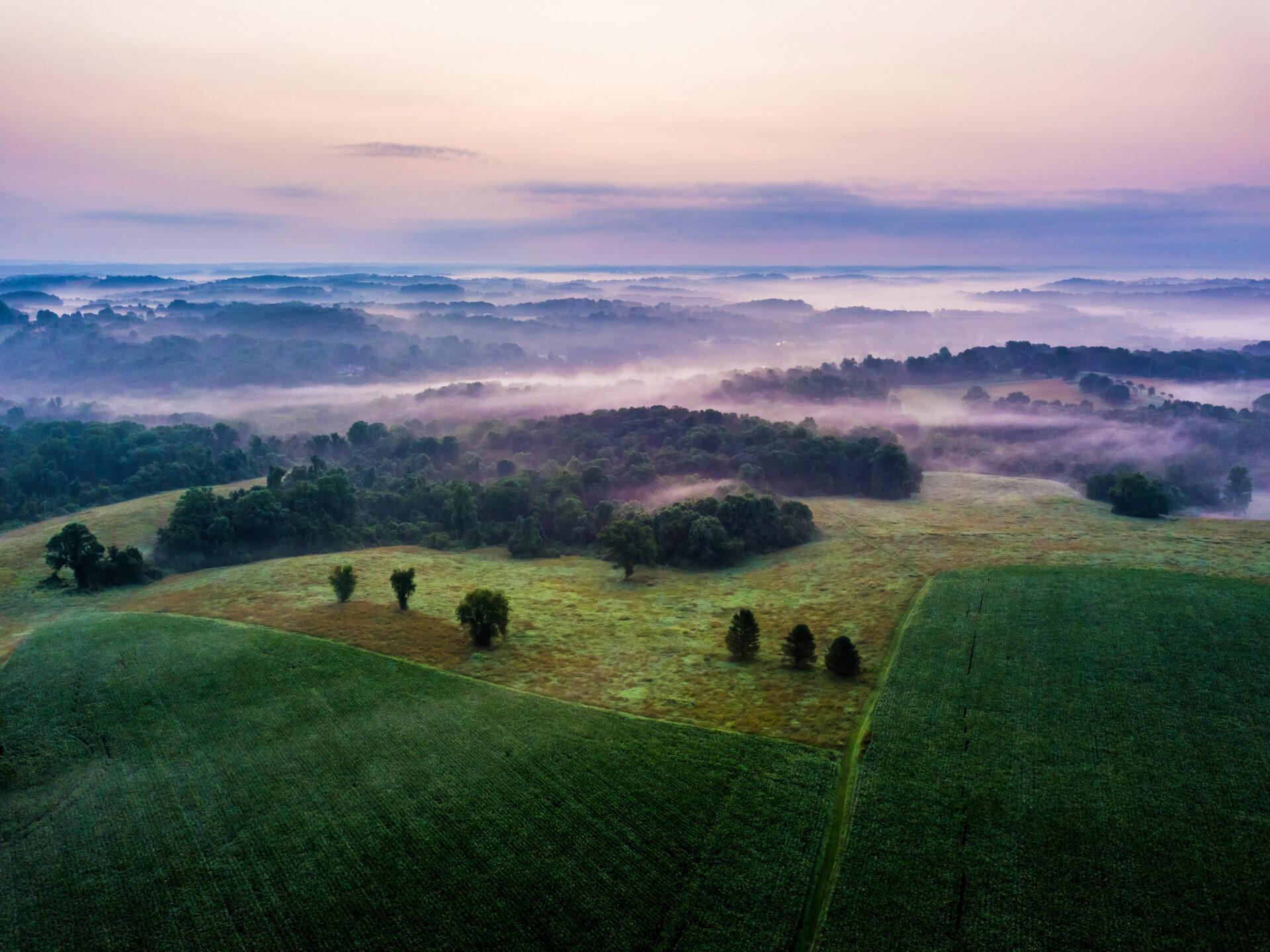
“Over the past decades, we’ve converted almost 1,000 acres of former farm fields to native grassland meadows,” said Gary Gimbert, vice president of stewardship. “
In 2025 alone, we installed meadows at ChesLen and Diabase Farm Preserves with a focus on pollinators, birds, and other wildlife that rely on this type of habitat for food, nesting, and—in the case of raptors—hunting sites.”
Grasslands are of particular importance to several species of native songbirds—including Bobolink, Eastern Meadowlark, and Grasshopper Sparrow—that build their nests on the ground, tucked between clumps of meadow grasses. With more and more land lost to development each year, grassland birds are really struggling, having lost a third of their numbers in the last half-century.
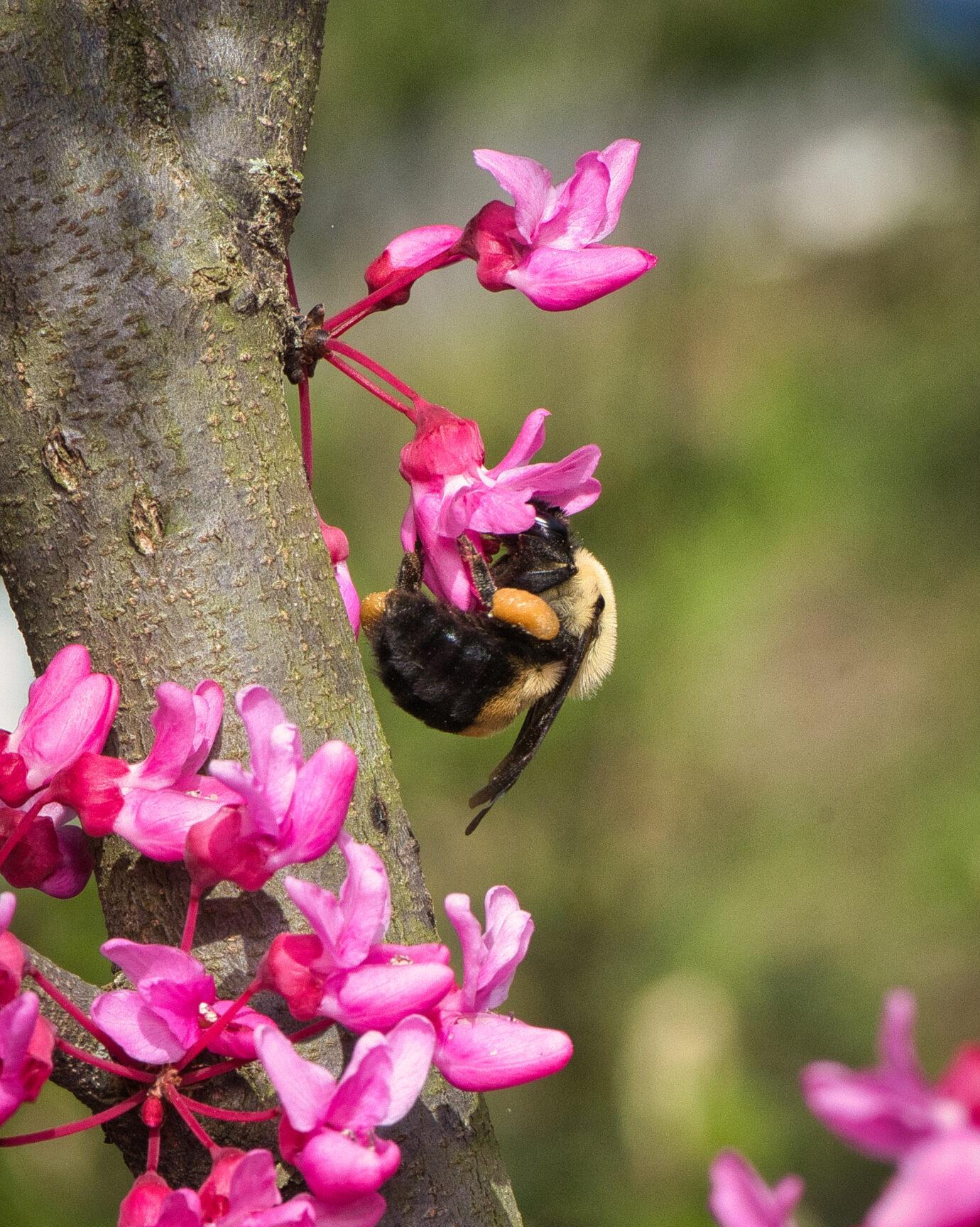
Meadows are also home to a vast array of nectar-rich wildflowers that support our native pollinators: bees, butterflies, moths, wasps, beetles, and flies.
“Over the years, we’ve learned a lot about how to create thriving meadows,” said Gary. “We can’t just plant grass and wildflower seeds and walk away. Meadows take regular maintenance, or they’ll be filled with invasives and eventually become forests.”
One important technique Natural Lands uses to keep its meadows healthy is fire. For 25 years, prescribed burns have been part of the organization’s comprehensive approach to land stewardship.
Many meadow species have evolved not only to withstand but also benefit from periodic burning. Two native grasses, big bluestem (Andropogon gerardii) and little bluestem (Schizachyrium scoparium), respond to fire by sprouting substantially more growth and setting more seeds. Fire stimulates the underground rhizomes of Indian grass (Sorghastrum nutans) and switchgrass (Panicum virgatum).
The secret to these and other native grasses’ survival of fire is their deep roots; three quarters of the plant is underground. The visible plants are merely the photosynthetic leaves gathering sunlight. These deep roots make meadow plants valuable carbon sinks. Unlike forests, they don’t release that carbon when burned because most of the plant material is under ground.
“The results speak for themselves,” said Darin Groff, director of land stewardship and burn boss for Natural Lands’ prescribed fire crew. “We walk away from a burn with the plants charred black. But very quickly after, you can see life—meadow grasses sending up new shoots, seedlings sprouting, hawks circling overhead.”
Added Darin, “Controlled burns aren’t a short-term fix. Meadow management takes ongoing effort from our land stewardship team.”
Fortunately for the birds, bees, butterflies, and blooms, Natural Lands is in the business of forever and will keep tending the remaining eastern prairies in our care.
benefits of prescribed fire.
- Helps control the encroachment of woody plants and the growth of invasive species
- Helps remove the buildup of dried plant material, which reduces the risk of wildfires
- Improves the release of nutrients from dead plant material so that they can be recycled through the ecosystem
- Warms the soil in early spring by allowing more sunlight to reach the ash-darkened ground, increasing microbial activity, further helping to release nutrients from dead plant matter
- Improves and increases food and cover for wildlife, as new growth flushes after fires and attracts grazing animals
- Improves plant diversity
training & testing before ignition.
by Fateen Stafford, 21st Century Conservation Fellow
On an early morning in April, a crew dressed in yellow and green wildland fire gear starts prepping its equipment. The drip torches are refueled, the backpack pumps are checked for any leakage, and the hand tools are sharpened. All these items are loaded onto the back of trucks and all-terrain vehicles that have been specially outfitted with water tanks, pumps, and a few hundred feet of hose.
This is the start of a burn day at one of Natural Lands’ meadows.
But long before the first blades of grass are ignited, Natural Lands stewardship staff goes through significant training to be certified in the use of prescribed fire.
The process starts with study—about 40 hours of it to pass five courses covering equipment and terminology, the Incident Command System, and working with peers in a high-risk environment. Each year, the Natural Lands fire crew participates in this training, which culminates in a Work Capacity Test. Every participant must walk two miles in 30 minutes with a 25-pound vest on, to simulate the weight of fire-fighting gear. A Field Test requires physical demonstration of all the skills learned online.
After my training this past spring, I had the confidence to use the drip torch to light a section of meadow at ChesLen Preserve, use hand tools to scrape back the dried winter grass so that the fire would be contained when it hit the bare soil, and “mop up” at the end of the burn by spraying down smoldering areas.
So, the next time you visit a Natural Lands meadow, you’ll have a little sense of the work that goes in to keeping these habitats healthy. One fire at a time.
next post


Bryn Coed Preserve Grows to 612 Acres
October 31, 2025
MEDIA, Pa., October 31, 2025 – Natural Lands announced today the addition of two adjacent, undeveloped parcels totaling 102 acres to its Bryn Coed Preserve […]
continue reading