


Touching the Stars: Making Astronomy Accessible to the Visually Impaired
August 19, 2026
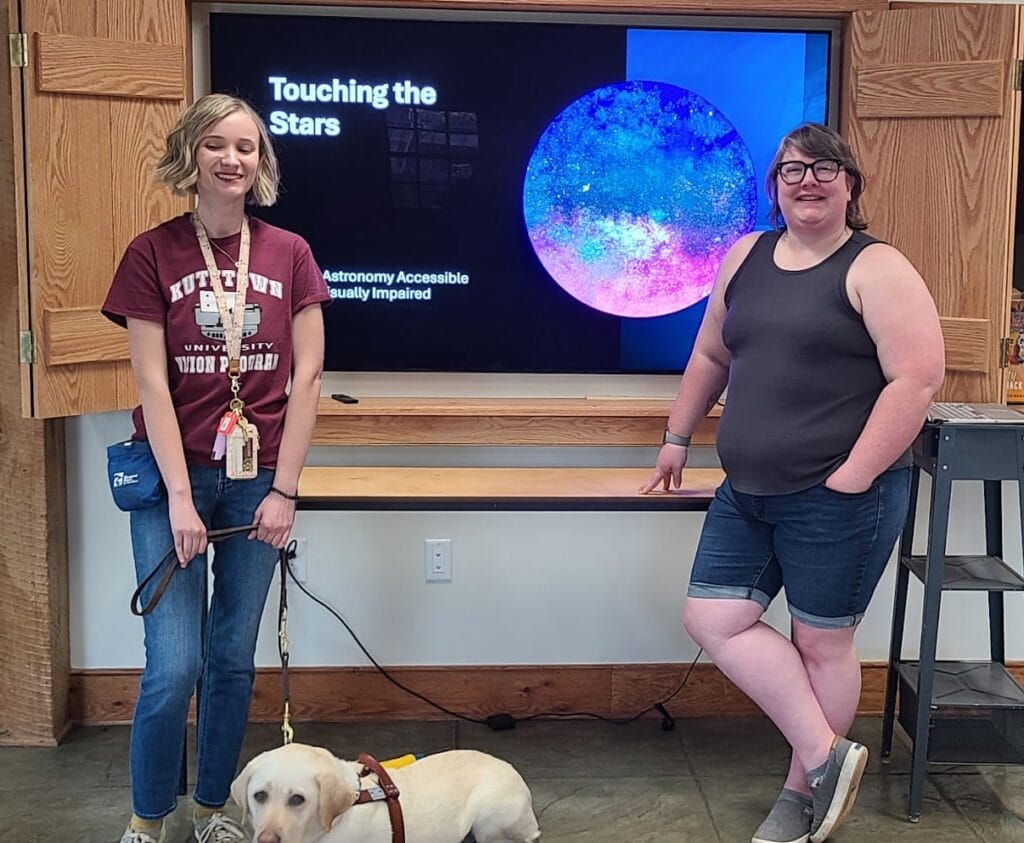
Jaylen Hallowell and Alicia Wood
by Alicia Wood, Berks County Intermediate Unit
akhornberger624@gmail.com
Astronomy, or rather stargazing, has long been considered a visual activity. The night sky can be dazzling, but what happens when your eyes don’t work like everyone else’s?
My name is Alicia Wood. I am a Teacher of the Visually Impaired and Certified Orientation and Mobility Specialist with Berks County Intermediate Unit, and the above question is exactly what my program hoped to decipher.
Before I talk about the program, let me give some background. As I stated, I work with the visually impaired population for a living. I work with students all around Berks County in Grades K-12. As part of my job each year, we are required to either complete a professional “project” or be observed by our supervisor. This program was partly inspired by this requirement. The other piece of inspiration was a conference session I had attended in Spring of 2023 when two professors from West Penn University presented on some tactile diagram booklets specific to the topics of Light Pollution and Eclipses they created in collaboration with NASA’s SSERVI Program. I had attended that conference session with my mom, who is now retired from doing the same job I do. She and my dad in recent years have gotten into astronomy, thanks to my sister and brother-in-law, and this past school year offered the time and opportunity for us to collaborate to use the information from that session to create the one-night program I held in April.
Thanks to my parents, sister, and brother-in-law, who are all heavily involved in the ChesMont Astronomical Society, I was able to get in contact with Molly Smyrl, the educator at Crow’s Nest Preserve in Elverson, PA. I am so grateful to Molly for letting me use Crow’s Nest to hold the event as it provided a perfect backdrop for everything. The event itself was originally intended to be an opportunity for students and their families to come together to have a multisensory activity evening, but as the date got closer, I found it was likely to turn into more of a public education event. The event itself consisted of multiple stations and various activities.
I started the evening with a brief PowerPoint presentation about the purpose of the event. Included in the PowerPoint was a video by Wanda Diaz-Merced, a blind astronomer.
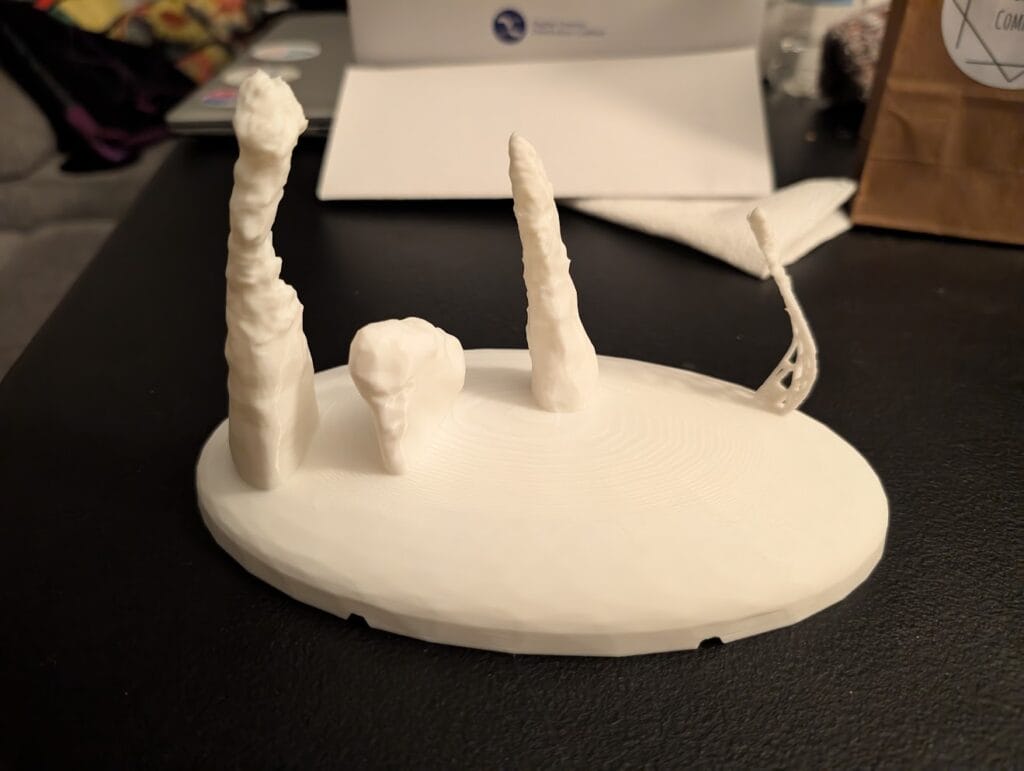
3D printout of the Pillars of Creation
My student teacher, at the time, Jaylen Hallowell, herself as an individual with visual impairment, ran a tactile craft station. At this station, she had pipe cleaners and star shaped beads in addition to cards with the formations of a handful of constellations visible in the skies at that time of year. People could make as many as they wanted!
Another station, run primarily by my mom, involved using iPads with Voiceover to utilize the SkyView/SkyView Lite app (available for both iOS and Android) to view the skies outside of Crow’s Nest.
A third station was self-guided and involved participants being able to interact with 3D printed models of things such as the Pillars of Creation, Gassendi Crater of the Moon, James Webb Telescope, and other items—all available as free resources through NASA’s 3D Resource Library. Alongside each model was a printed and braille embossed description of the model.
Finally, I was fortunate to have my brother-in-law, who is the current president of ChesMont Astronomical Society, set up one of his telescopes for participants to be able to do some deeper viewing into the skies. This station was not inherently accessible to someone with limited or no vision, but part of my presentation had discussed programs that are available commercially that can be downloaded and utilized on a computer with a screen reader in order for someone to utilize a telescope and have the visual described aloud.
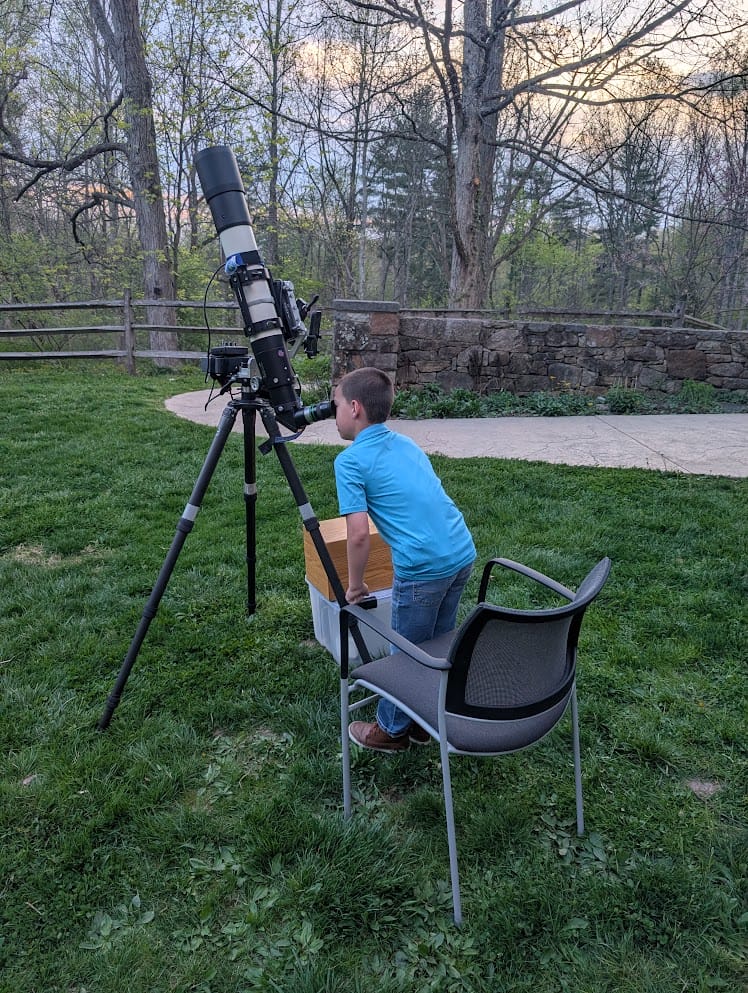
The program itself brought in about a dozen people, including friends and family of mine that came to support me. I was fortunate that they also brought some friends and/or family with them, and overall, everyone seemed to end the evening with some new information and fun experiences!
I am, once again, so grateful to Natural Lands and to Molly for allowing me the opportunity to host this program. At the time, I planned it as a one-and-done kind of thing. However, I am always happy to talk to others about ways to make things accessible, so maybe I’ll have a chance to run this again sometime!
next post


June Reflections on Stardust
August 12, 2026
By Jarrodd Davis, NextGen Council Chairperson The wicked weather of this summer in our region—five heatwaves (and counting), monumental downpours, blustery winds, and the haze […]
continue reading