
Blog

Posts categorized Butterfly.

Mariton: Butterflies

by Tim Burris, Preserve Manager

(Red Admiral by Carole Mebus)

There has been a lot of butterfly activity.  On a recent walk (without binoculars or a field guide) I saw several species.  Red Admirals, American Ladies, Spicebush Swallowtails, Mourning Cloaks, Sulphurs, and a (Northern?) Cloudywing were some of the butterflies I could identify.

Mariton: Butterflies and Blossoms

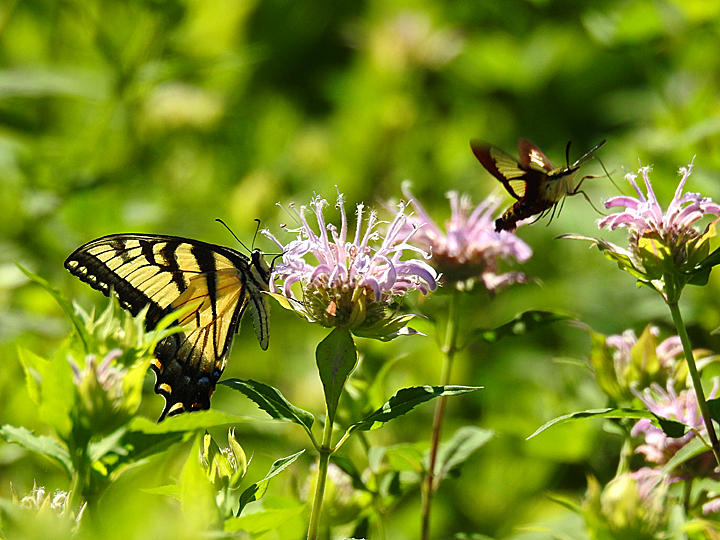
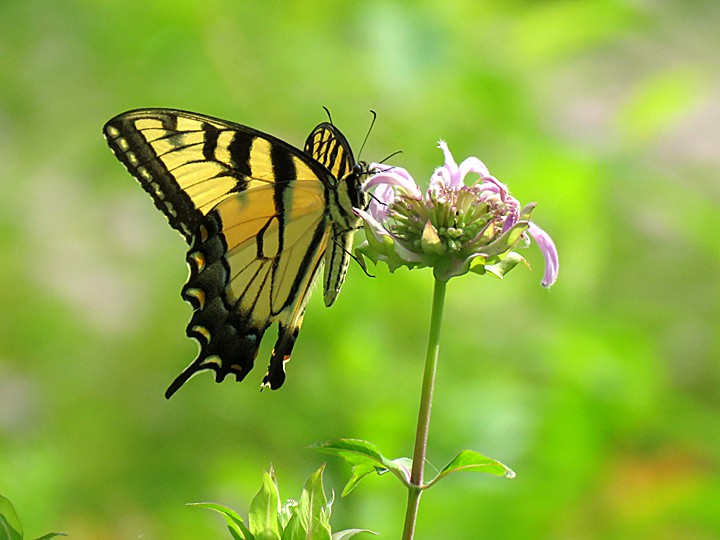
Even though I mowed one meadow this week, the other three are thriving.  One of the meadows is full of Bergamot (Monarda fistulosa).  The butterflies are loving it.  Carole Mebus visited and these are some of her great photos of flowers and butterflies. 

This Pipevine Swallowtail (Battus philenor) is a great find.  It’s main food plant is an ornamental Pipevine (Aristolochia).  It also uses the native Dutchmen’s Pipe (A. macrophylla).  I haven’t found either of these plants at Mariton, so it must be utilizing another plant for food.  We have been seeing Pipevine Swallowtails occasionally for the last few years.

Spicebush (Lindera benzoin) is a very common plant here, as is Sassafras  (Sassafras albidum).  These are the major food plants for the Spicebush Swallowtail (Papilio troilus), and we see lots of Spicebush Swallotails at Mariton.  It is fairly easy to see the differences in these similar looking butterflies when they are photographed posing on a flower.  However, I still have trouble telling them apart when they fly by quickly… and butterflies can really move when necessary.  (All photos by Carole Mebus.)

Mariton: Butterflies

The last Butterfly Walk for the season was held on Tuesday.  We are finally seeing good numbers of Spicebush Swallowtails (Papilio troilus).  Their main food plant is Spicebush (Lindera benzoin), but they also like Sassafras (Sassafras albidum).  Both plants are abundant at Mariton. 

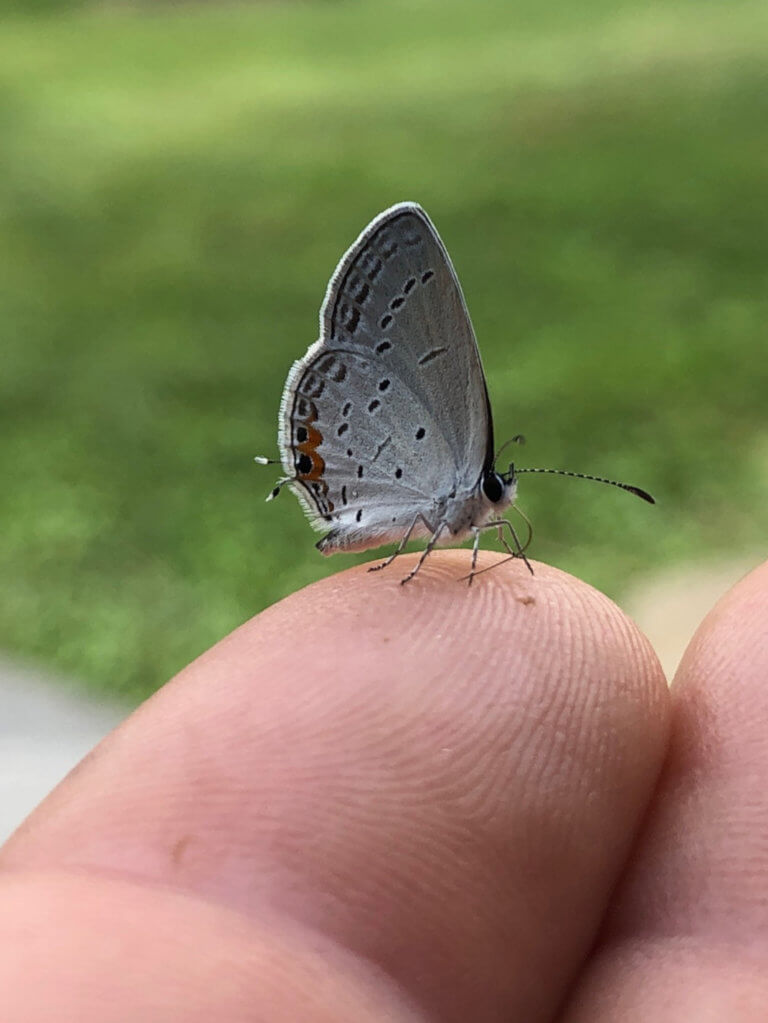
Probably the highlight was this female Eastern-tailed Blue (Everes comyntas).  This is another tiny butterfly that is worth a closer look.  Carole Mebus took both photos, one with the wings closed, and the other with the wings open. 


Mariton: Butterfly Census

Butterfly count

Today we held the 21st Annual Butterfly Census.  We had good weather and six butterfly enthusiasts.  We ended the morning with 20 species and 147 individuals. 

The most common butterfly was the Great-spangled Fritillary.  We counted 30 individuals.  While that is a big name, the butterfly is pretty spectacular when the sun catches the white spots underneath its wings.  This is an easy-to-learn and common butterfly at Mariton.  Its major food plant (what the caterpillars eat) are different violets.  Photo by Carole Mebus.

The next most common species was the Silver-spotted Skipper (29 individuals).  Another butterfly that is fairly easy to recognize.  The silver spot on its underwing is the giveaway.  Photo by Carole Mebus.

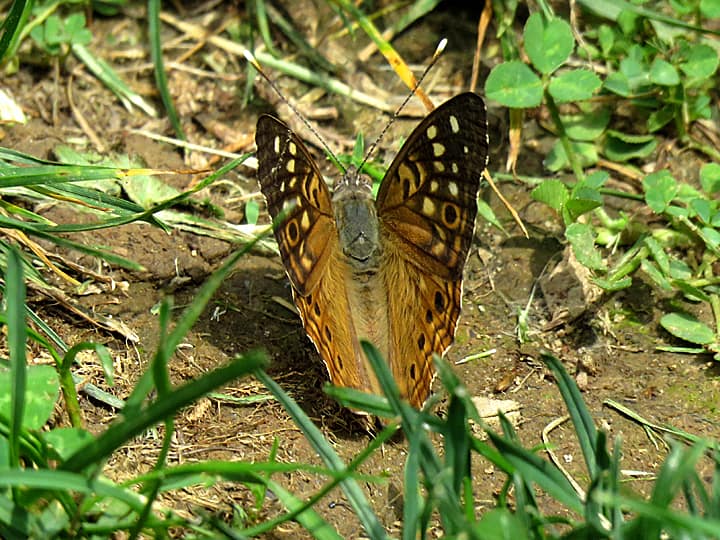
Another species, though not very common this morning was the Hackberry Emperor.  There are patches of Hackberry trees on the preserve, so we often see this beautiful butterfly.  This is a species that is often lands on people to gather salts from their skin.  Photo by Carole Mebus.

Mariton: Common Buckeye

The Tuesday Butterfly Walk was warm, but cloudy.  The Butterflies seemed reluctant to show themselves, so we didn’t see much variety.  We did, however, see a Common Buckeye.  This is a beautiful butterfly, that is easy to see with the naked eye.  The huge eye spots on the wings deter predation from birds and other animals.  Birds perceive the large eye spots as part of what must be a larger head, and thus a larger animal. They are pretty.

We also saw a Crossline Skipper.  This butterfly is small and its markings are subtle and very similar to other skippers.  (At least, I think it looks similar to other skippers.)  Photos by Carole Mebus.

Saturday Mariton will hold its Annual Butterfly Census at 9:00 a.m.  You are welcome to join us.  Bring binoculars, or borrow ours.  Next Tuesday is the last Butterfly Walk of the summer.  The Milkweed and Butterfly Weed should both be in bloom, so if the weather cooperates, we should have some good sightings.

Mariton: Banded or Hickory?

Photo by Carole Mebus

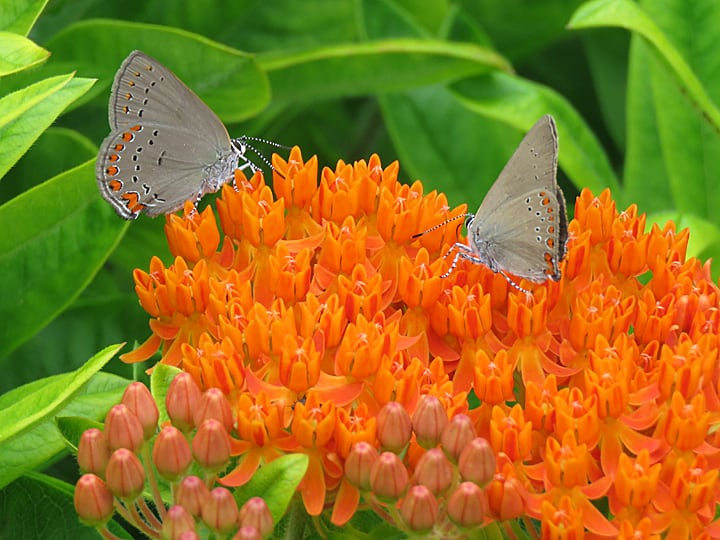
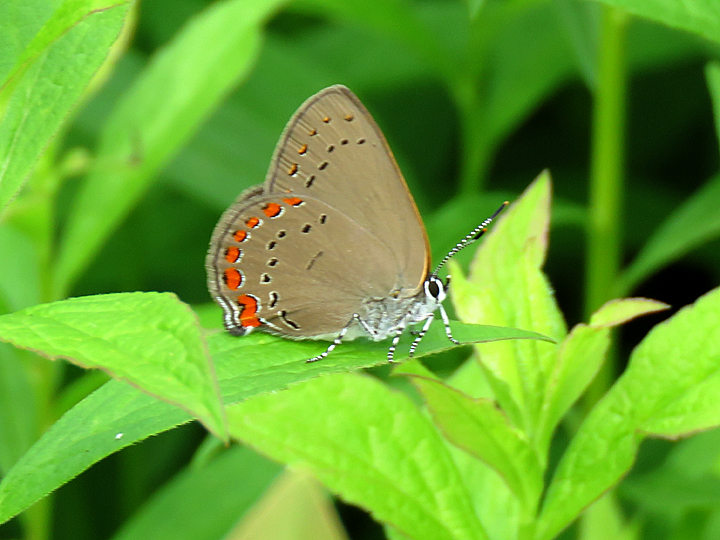
On Tuesday’s Butterfly Walk we saw 13 butterfly species.  The one that has garnered the most attention was a Hairstreak that looks like a Hickory Hairstreak (Satyrium caryaevorum), but might in fact be a Banded Hairstreak (S. calanus).  Taxonomy aside, it is a very beautiful butterfly, but very small. 

I respect Virginia Derbyshire’s opinion that it is a Banded Hairstreak.  So, I spent a lot of time reviewing Jeffery Glassberg’s Butterflies Through Binoculars -The East.  Then I flipped back and forth through the photos taken by Carole Mebus and Bill Roehrig.

The key to me switching my vote (besides Virginia’s opinion) was Glassberg’s note that the Banded Hairstreak is common and variable.  Glassberg uses the blue dot on the hind wing as a field mark.  In the Hickory, the blue dot should stick out well beyond the orange dots.  Our butterfly has a blue dot that is pretty much in line with the orange, an indicator of a Banded Hairstreak.  Take note of the three bars closest to the butterflies body.  You will see that the bottom one is offset from the other two, instead of in line.  Again, a characteristic of the Banded Hairstreak.   (But I could be wrong.)

It is these subtle little differences that make butterflies so frustrating for me -and- an interesting challenge.  The more I learn about butterflies, the more I realize that binoculars and field ID are not enough.  You have to take excellent photos and analyze them back at home.  (Fortunately, we have good photographers on our Butterfly Walks.)  It is reassuring that technology now allows us to do the lab work without pinning the butterflies to a piece of cardboard.  Of course, you don’t need to get caught up in taxonomy.  Butterflies are amazing creatures that are worth appreciating for their beauty alone.

I said they were small.  Look at this photo that Bill Roehrig took of the same butterfly.  Note the small fly on the same leaf for scale.

Photo by Bill Roehrig

Mariton: Butterfly Season

The Tuesday Butterfly Walks began this morning, and we saw about ten species of butterflies.  That is a great number for this early in the season.  The milkweeds aren’t open yet, and there are limited flowers producing nectar in the meadows, so we were surprised by how much we saw.  The most common butterfly was the Little Wood Satyr (Megisto cymela).  Everywhere we walked there were 3 – 4 flying about, especially along the trails bordering the woods.

One of the interesting species was the Gray Hairstreak (Strymon melinus), which is a tiny butterfly with beautiful markings.  This specimen is missing a part of its forewing. 

The Spring Azure (Celastrina ladon) is another small butterfly worth checking out with a pair of binoculars.  There is a lot of variation in how blue these butterflies are, but the markings on this individual are really nice.

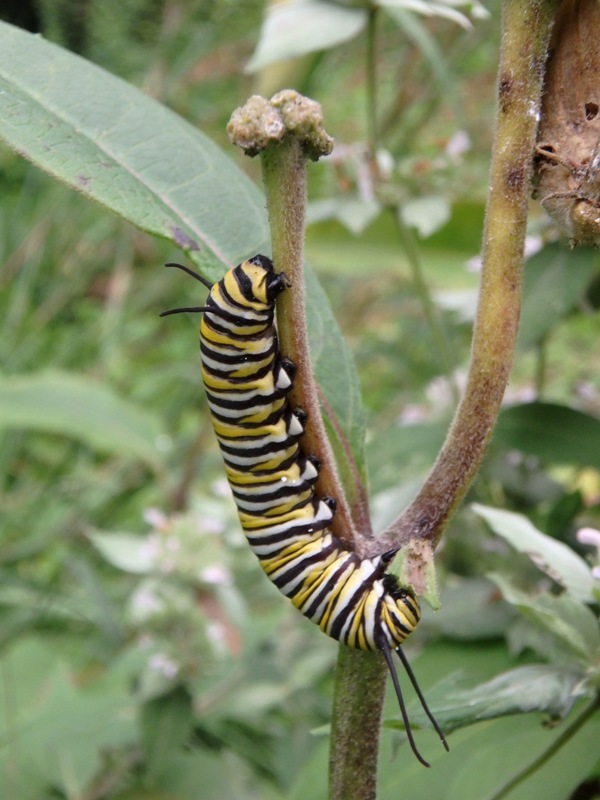
We saw Silver-spotted Skippers, Hoary Edges, Northern Cloudywings, Eastern Tiger Swallowtails, Spicebush Swallowtails, Great Spangled Fritillaries, and Question Marks.  This is a really bright looking Monarch (Danus plexippus) on a milkweed that is just about to open.  Another week and we should add more species and more activity.  (All photos by Carole Mebus.)

Archives